
Why are so many young kids getting braces? Are braces being started earlier these days? Should braces be started when baby teeth are still present? Why not just wait until all the permanent teeth are in? When should I have my child first seen by an orthodontist? These are some of the most common questions I receive by parents asking about orthodontic treatment for their child in Temecula. If you are a parent and have questions about the development of your child’s teeth then I hope this article will help clear up any of the confusion.
Orthodontists are dental specialists trained to diagnose and correct tooth alignment problems as well as skeletal and facial growth imbalances. These problems and imbalances can be identified and corrected by a well trained orthodontist when your child still has baby teeth present as early as 7 years of age. Although many orthodontic problems either can’t be treated or don’t need to be treated at an early age, almost all orthodontic problems can be identified by age 7 while baby teeth are still present.
The Most Common Reasons for Early (Phase 1) Orthodontic Treatment
Underbite (Anterior Crossbite): The cause can be dental, skeletal, or a combination of the two. Early treatment is critical as the majority of upper jaw growth occurs around age 7. Tooth trauma and gum recession is also likely to occur as a result of this type of bite.
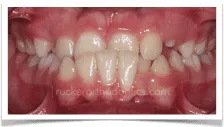
Posterior Crossbite: Just like an underbite, the cause can be dental, skeletal, or a combination of the two. It also needs to be treated early for the same reasons. In addition, posterior crossbites also create crowding since the arch form is narrower than what it needs to be to match the larger arch form of the lower jaw.
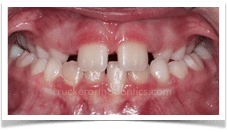
Crowding: This is one of the most common reasons for early orthodontic treatment. Simply put, adult sized teeth are trying to fit in child sized jaws. This mismatch creates an obvious dental situation in which arch development, or widening, through orthodontic treatment is required to create space for permanent tooth eruption. Early correction can also prevent more serious complications such as tooth impactions.
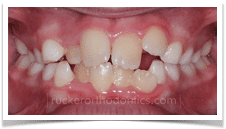
Spacing: A large gap between the upper front teeth will almost never close without braces. Most often the gap is caused by the lip attachment, or frenum, being positioned too far down between the teeth. The excessive spacing takes up too much space for other permanent teeth to otherwise erupt normally.
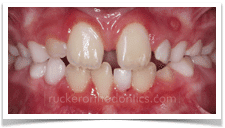
Anterior Open Bite: This type of bite is typically created by a bad habit, such as tongue thrust or thumb sucking. The habit creates a skeletal imbalance, or malformed jaw, which in turn creates a dental problem. Eliminating the habit at a young age is critical in establishing normal jaw form and dental function.
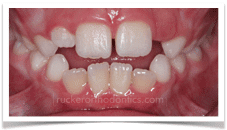
Deep Bite (Overbite): Too much closure of the top teeth over the bottom teeth can cause gum damage to the roof of the mouth. It also causes the lower face to appear shorter and collapsed. It is important to correct a deep bite early to allow the back teeth to erupt normally, protect the health of the gums, and allow for better facial growth.
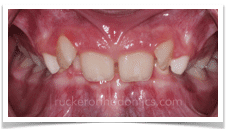
Impacted and Missing Teeth: Most of the time impacted or missing teeth are due to genetics and are best treated with early diagnosis. Timing of orthodontic treatment is critical in keeping treatment options available when all the other permanent teeth have erupted.
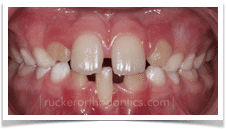
Ectopic Eruption: There are several reasons why a tooth will erupt in a location outside the normal position. Early alignment is critical while many baby teeth are falling out and permanent teeth are erupting.
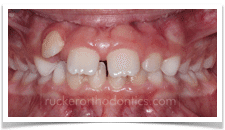
Protrusive Front Teeth: When front teeth are positioned too far forward they are at a much higher risk for tooth trauma from sports or other physical activities.
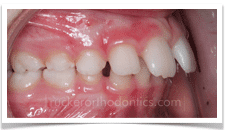
Not every child needs early orthodontic treatment, but I do recommend that all children be seen by an orthodontist by age 7. The purpose of early treatment is to achieve the best possible smile and facial balance for your child while minimizing the need for more invasive treatment (permanent tooth extractions, headgear, oral surgery, and extended treatment times, etc) when all the permanent teeth are in.
We offer a free exam and consultation, so why not give us a call at (951) 302-0685 today?
NOTE: The author, Dr. Jonathan Rucker, is a certified specialist in orthodontics (Orthodontist). His private orthodontic practice, Rucker Orthodontics, is located in Temecula, California. He received a Bachelor of Science degree at Brigham Young University, his Doctor of Dental Surgery (DDS) from the Medical College of Virginia, and his orthodontic specialty training at Saint Louis University Center for Advanced Dental Education. He is a certified Damon Braces provider and a preferred Invisalign specialist. He offers the most advanced techniques available in modern orthodontic treatment to ensure his patients have a positive and memorable experience while giving them the best possible results.