
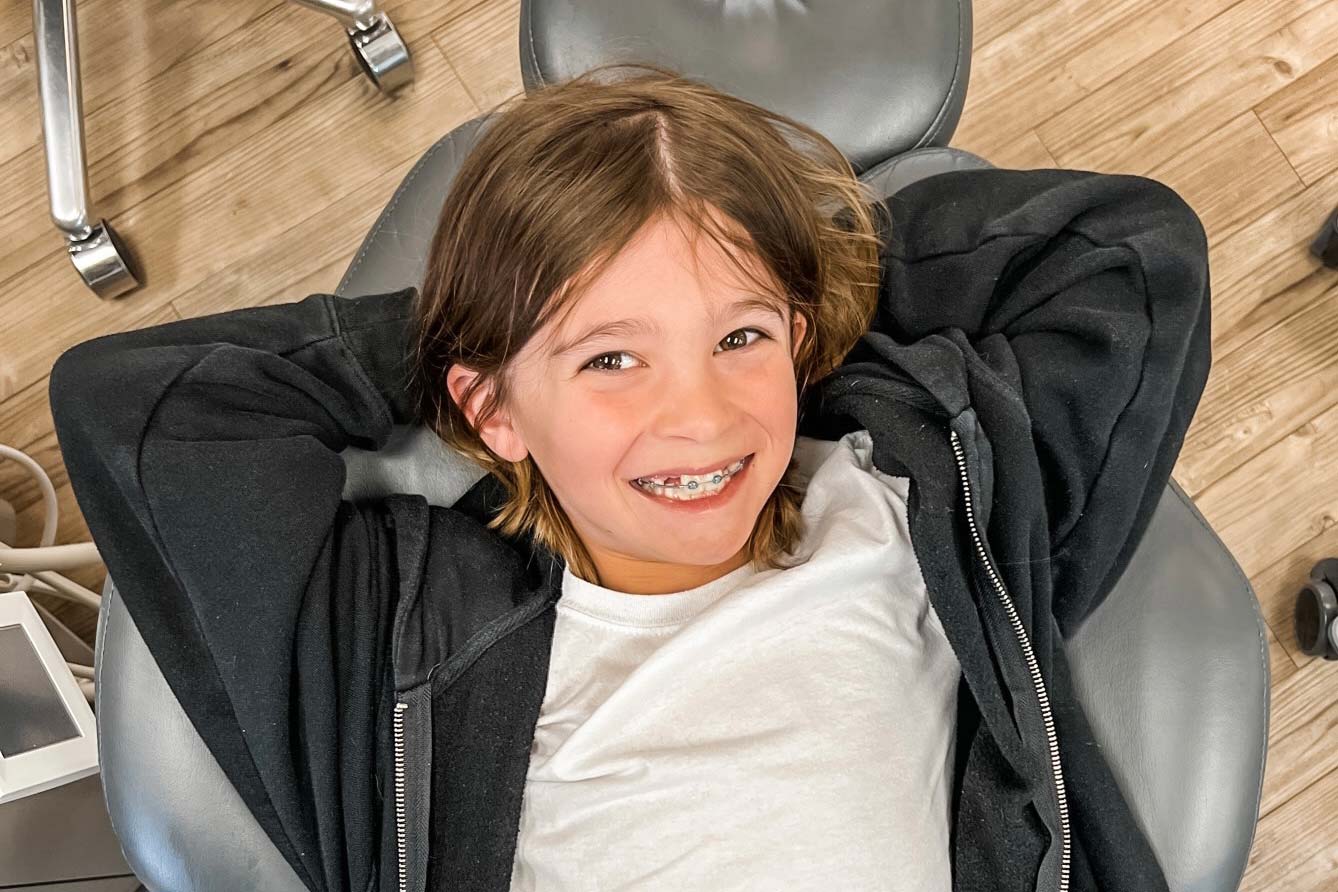
Early treatment in a 7- to 9-year-old guides jaw growth and makes room; teen treatment aligns a full set of permanent teeth and finishes the bite. Same appliances in many cases — different goals, shorter phases and different decisions for parents.
Do kids and teens get braces for different reasons?
Largely, yes. In a younger child, orthodontics is usually about creating conditions: enough room for permanent teeth, a crossbite corrected before it wears enamel, a habit interrupted, jaw width improved while the bones are still adaptable. In a teenager, most or all permanent teeth are present, so treatment is about the finished result — alignment, bite and stability. That difference is why an eight-year-old’s treatment might last well under a year while a teenager’s runs closer to two.
Why age seven is the usual first evaluation
By about seven, the front permanent teeth and first molars are coming in, so an orthodontist can see arch width, crowding trends, bite relationship and eruption patterns at the same time. Most children evaluated at that age need nothing except monitoring. The value of the visit is the small group it catches: crossbites, severe crowding, impacted or missing teeth, and habits that are actively changing how the jaws grow.
What does treatment look like at ages 7 to 9?
Phase 1: short, targeted, growth-based
Early treatment is deliberately limited. It targets one or two specific problems — widening a narrow upper arch, correcting a crossbite, or making space so a permanent tooth can erupt where it belongs — and then stops. It is not a first attempt at straightening all the teeth, and parents are sometimes surprised that their child’s teeth are not perfectly aligned when a phase ends. That was never the goal. Our two-phase treatment overview lays out how the phases fit together.
Partial braces and appliances
At this age, treatment often uses an expander or partial braces on a few teeth rather than a full set of brackets. Some children need only a habit appliance or a space maintainer. Appliance choice at this stage is dictated by what is being corrected and by how much growth is left to work with.
What early treatment can prevent
Guiding growth can reduce the odds of a permanent tooth erupting into a position that damages a neighboring root, of a crossbite wearing down enamel for years, or of severe crowding needing extractions later. It does not guarantee that braces will be skipped. Framing it as “braces now instead of braces later” is the most common misunderstanding — and an anterior crossbite is a good example of a problem that genuinely gets harder to fix the longer it waits.
What happens between ages 10 and 12?
The resting phase
Between an early phase and full treatment there is usually a resting period where the remaining permanent teeth erupt. Nothing is being done, but the child is still being watched at regular intervals. Skipping those checks is how a favorable case becomes a complicated one: the point of monitoring is to catch an erupting tooth going the wrong direction while redirecting it is still simple.
Deciding when full braces begin
Full treatment usually starts once the permanent teeth are in or nearly in. Timing is judged on dental development rather than birthdays — two twelve-year-olds can be a year apart in readiness. In cases where jaw growth is being used to correct a bite, starting before the growth spurt matters more than waiting for the last baby tooth.
Mixed dentition means mixed mechanics
Treating a mouth that holds both baby and permanent teeth requires care, because baby teeth are not stable anchors and will be lost mid-treatment. This is one of the practical reasons early phases are short and targeted rather than comprehensive.
What is different about braces for teens?
Full treatment, full bite correction
Teen treatment addresses the whole arch and the bite together: crowding, rotations, spacing, overbite, overjet and the way the back teeth fit. Because the permanent teeth are present, the finish is the finish — there is no later phase to correct what is left. See our braces for teens information for how full treatment is structured.
Compliance becomes the variable
With younger children, parents control most of the plan. With teenagers, the plan depends on the patient: elastics worn as instructed, aligners in for 20 to 22 hours if trays were chosen, appliances not broken, hygiene maintained around brackets. Almost every teen case that runs long runs long for one of those reasons, not because the teeth were unusual.
Appearance actually matters here
Teenagers care what braces look like, and dismissing that is a good way to end up with a patient who does not cooperate. Clear brackets, Damon Clear and Invisalign Teen exist for that reason. So do mouthguards for athletes — a bracket-friendly mouthguard is not optional for contact sports, and we cover options with our retainers and mouthguards information.
Retention starts the day braces come off
Teenage jaws keep changing into the early twenties, so retainers are what protect the result. A permanent wire, a removable retainer or both may be used, and the wear schedule is individual. If something loosens or breaks, it needs an appointment quickly — see what to do about a loose or broken permanent retainer.
How do the two stages compare?
| Ages 7–9 (early phase) | Ages 10–12 (transition) | Teen years (full treatment) | |
|---|---|---|---|
| Main goal | Guide growth, make room, stop damage | Monitor eruption, time the start | Align teeth and finish the bite |
| Typical appliances | Expander, partial braces, habit appliance | Usually none; observation visits | Full braces or aligners, elastics |
| Length | Short and targeted | Watchful waiting | The longest stage |
| Who drives success | Parents | Parents keeping the check-ups | The teenager |
| Common misunderstanding | “This replaces braces later” | “Nothing is happening, so we can skip visits” | “Retainers are optional once it looks straight” |
How can parents tell which stage their child is in?
Useful signals at home: baby teeth lost much earlier or later than siblings, permanent teeth erupting behind or in front of the arch, a jaw that shifts to one side on closing, front teeth that do not meet, mouth breathing or noisy sleep, difficulty chewing, or a bite where the lower front teeth close in front of the uppers. None of these is a diagnosis — they are reasons to have a specialist look. Persistent mouth breathing and disrupted sleep in particular are worth mentioning, because they connect to airway orthodontics rather than to alignment alone.
What a first visit involves
A consultation with Dr. Jon Rucker or Dr. Ryan Rucker is complimentary and includes an examination, a digital iTero scan where appropriate, and a plain-language recommendation: treat now, wait and monitor, or nothing needed. You will leave knowing which of the three applies. Both brothers are orthodontic specialists — you can read more about them here — and they see families at our Temecula and Murrieta offices. Call (951) 302-0685 to schedule.
Frequently asked questions about kids’ and teens’ braces
Is it bad to wait until all the permanent teeth are in?
For most children it is completely fine, and that is the normal path. The exceptions are the cases where growth is the treatment tool — crossbites, severe crowding, significant jaw discrepancies — where waiting narrows the options.
Will my child need braces twice?
Children who have an early phase usually do have full braces later, because the early phase was solving a different problem. That is expected, not a failure of the first phase.
Does my child need a referral from the dentist?
No. You can book an orthodontic consultation directly, and the consultation is complimentary. Many families come in because their general dentist suggested it, but a referral is not required.
Are braces for kids more expensive than for teens?
Fees follow complexity and length, so a short early phase and a full course of treatment are priced differently. Two-phase treatment is discussed as two separate stages, and payment and insurance options are reviewed at the consultation — see financial information.
My teenager plays sports. Can they still have braces?
Yes, with a mouthguard designed for braces. Athletes are one of the cases where metal brackets may be the more practical choice.